A stone is thrown horizontally with an initial speed of $30\ \mathrm{\displaystyle \frac{m}{s}}$ from a bridge. Find the stone’s total speed when it enters the water 4 seconds later, assuming that air resistance is negligible.
A) $30\ \mathrm{\displaystyle \frac{m}{s}}$
B) $40\ \mathrm{\displaystyle \frac{m}{s}}$
C) $50\ \mathrm{\displaystyle \frac{m}{s}}$
D) $60\ \mathrm{\displaystyle \frac{m}{s}}$
A) $30\ \mathrm{\displaystyle \frac{m}{s}}$
B) $40\ \mathrm{\displaystyle \frac{m}{s}}$
C) $50\ \mathrm{\displaystyle \frac{m}{s}}$
D) $60\ \mathrm{\displaystyle \frac{m}{s}}$
After 4 seconds, the stone’s vertical speed has changed by
$$\Delta v_y=a_yt$$
$$\Delta v_y=\left(10\ \mathrm{\frac{m}{\ s^2}}\right)(4\ \mathrm{s})$$
$$\Delta v_y=40\ \mathrm{\frac{m}{s}}$$
Since $v_{0y}=0$, the value of $v_y$ at $t=4$ is $40\ \mathrm{\displaystyle \frac{m}{s}}$.
The horizontal speed does not change. Therefore, when the rock hits the water, its velocity has a horizontal component of $30\ \mathrm{\displaystyle \frac{m}{s}}$ and a vertical component of $40\ \mathrm{\displaystyle \frac{m}{s}}$.
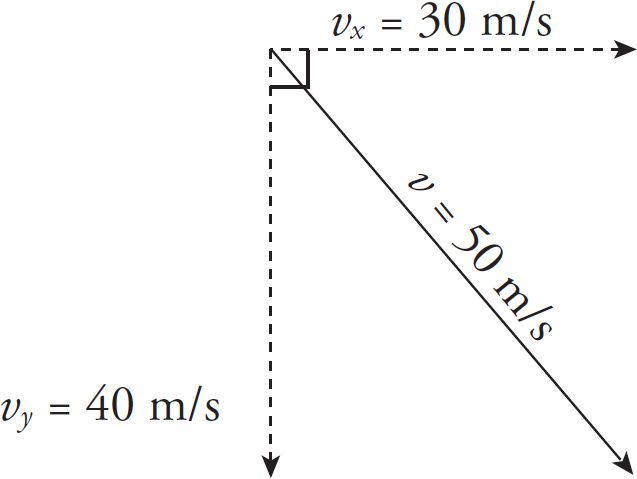
By the Pythagorean Theorem, the magnitude of the total velocity, $v$, is $50\ \mathrm{\displaystyle \frac{m}{s}}$.