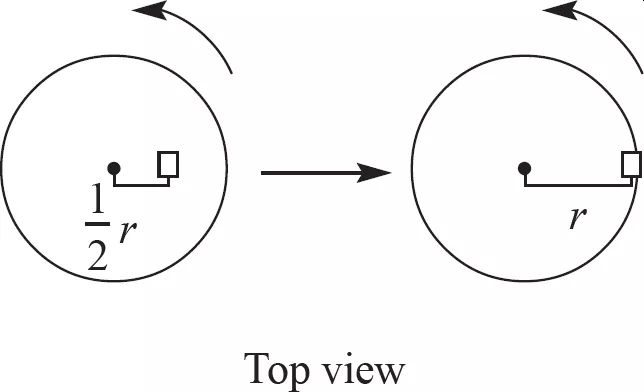
An object is resting on a platform that rotates at a constant speed. At first, it is a distance of half the platform’s radius from the center. If the object is moved to the edge of the platform, what happens to the centripetal force that it experiences? Assume the platform continues rotating at the same speed.
A) Increases by a factor of $4$
B) Increases by a factor of $2$
C) Decreases by a factor of $2$
D) Decreases by a factor of $4$
A) Increases by a factor of $4$
B) Increases by a factor of $2$
C) Decreases by a factor of $2$
D) Decreases by a factor of $4$
The formula for centripetal force is
$$F_{\mathrm{c}}=\frac{mv^2}{r}$$
which initially seems to indicate the force is inversely proportional to the radius. However, in the case of circular motion, an object’s linear speed is
$$v=\omega r$$
Substituting this value into the equation gives
$$F_{\mathrm{c}}=\frac{m(\omega r)^2}{r}$$
$$F_{\mathrm{c}}=m\omega^2r$$
So it turns out that the force is directly proportional to $r$, which means doubling the radius will double the force on the object.