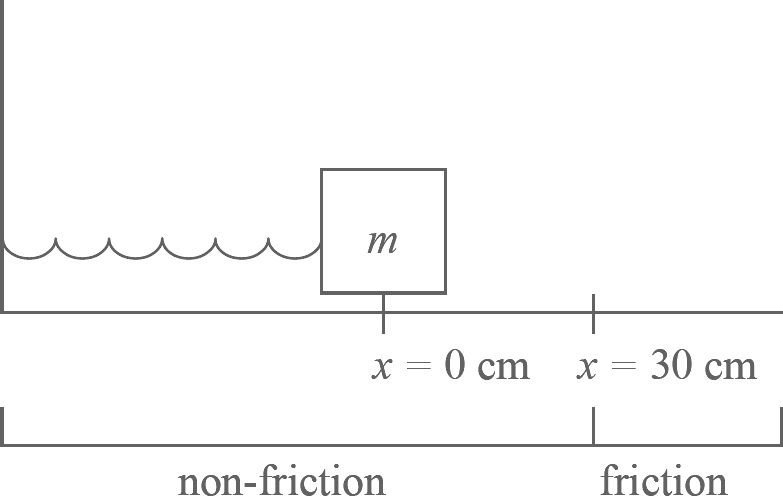
In the diagram above, a spring-block system is oscillating on a flat horizontal surface. Part of the surface is frictionless, and part of the surface is not frictionless. The block starts at rest at position $x=0\ \mathrm{cm}$. The block is then pushed to the left, compressing the spring, until it reaches the position $x=-50\ \mathrm{cm}$. After being pushed in, the block is released and allowed to move naturally.
a) Draw a graph of the system’s position as a function of time starting from the moment it is released and explain your reasoning behind the graph you draw. Be sure to label important values on the graph.
a) Your graph should look like this: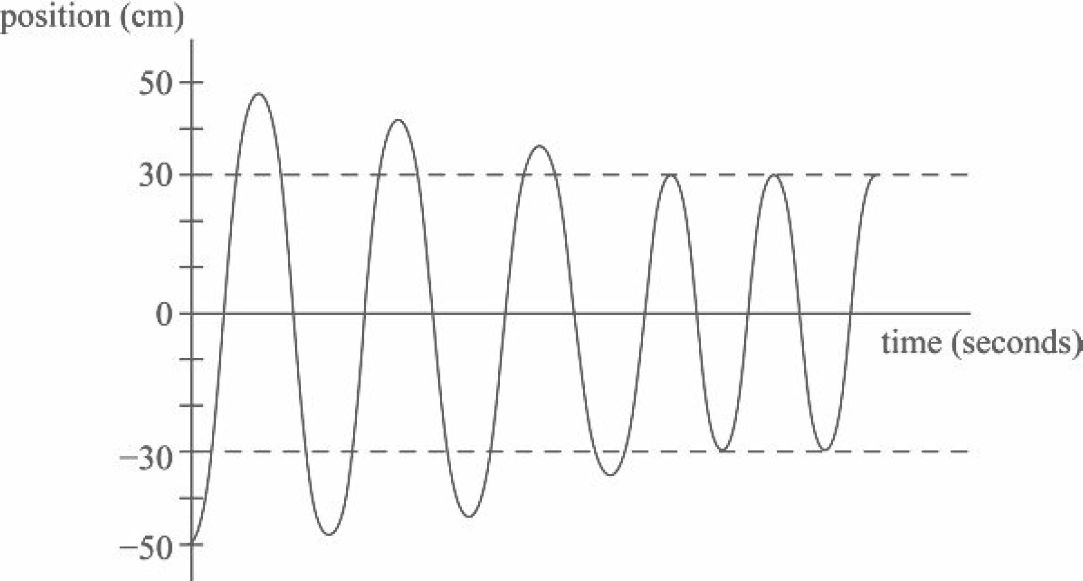
First, it must start at position $-50$ as the problem indicates. Second, it must go up to a point that is nearly $50$ but not quite. This is because the frictional surface will remove some of the energy from the system as the block slides across it. Each time the block swings back to the frictional surface, it will drain a little more of the energy, making the amplitude slowly taper off until it eventually is only on the frictionless surface. Because the frictionless surface extends to $30\ \mathrm{cm}$, it will oscillate between that point and $-30\ \mathrm{cm}$ indefinitely.
b) Given that the mass $m=2\ \mathrm{kg}$ and the spring constant $k=100\ \mathrm{\displaystyle \frac{N}{m}}$, what is the magnitude of work done by the non‑frictionless surface?
b) The energy of a spring system can be found by
$$PE=\frac{1}{2}(100)(0.5)^2$$
$$PE=\frac{100}{8}$$
$$PE=12.5\ \mathrm{J}$$
After the oscillations have tapered off, it will have a new energy of
$$PE=\frac{1}{2}(100)(0.3)^2$$
$$PE=4.5\ \mathrm{J}$$
Therefore, the frictional surface has caused $8\ \mathrm{J}$ of energy to be lost.