A box slides down an inclined plane (incline angle $=37^\circ $). The mass of the block, $m$, is $35\ \mathrm{kg}$, the coefficient of kinetic friction between the box and the ramp, $\mu_{\mathrm{k}}$, is $0.3$, and the length of the ramp, $d$, is $8\ \mathrm{m}$.
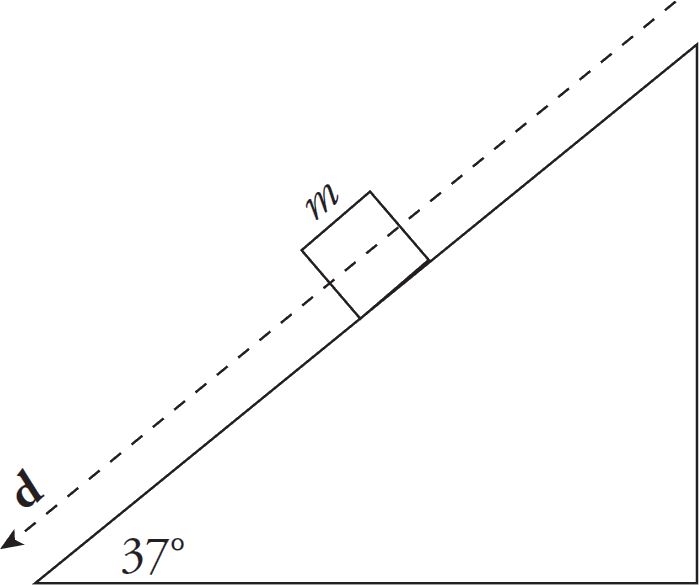
a) How much work is done by gravity?
$W_{\mathrm{by\ gravity}}=1690\ \mathrm{J}$
a) Recall that the force that’s directly responsible for pulling the box down the plane is the component of the gravitational force that’s parallel to the ramp:
$$F_{\mathrm{w}}\sin{\theta }=mg\sin{\theta }$$
(where $\theta $ is the incline angle).
This component is parallel to the motion, so the work done by gravity is
$$W_{\mathrm{by\ gravity}}=(mg\sin{\theta })d$$
$$W_{\mathrm{by\ gravity}}=(35\ \mathrm{kg)\left(10\ \displaystyle \frac{N}{kg}\right)(\sin{37^\circ })(8\ m)}$$
$$W_{\mathrm{by\ gravity}}=1690\ \mathrm{J}$$
Note that the work done by gravity is positive, as we would expect it to be, since gravity is helping the motion. Also, be careful with the angle $\theta $. The general definition of work reads $W=(F\cos{\theta })d$, where $\theta $ is the angle between $\textbf F$ and $\textbf d$. However, the angle between $\textbf F_{\mathrm{w}}$ and $\textbf d$ is not $37^\circ $ here, so the work done by gravity is not $(mg\cos{37^\circ })d$. The angle $\theta $ used in the calculation above is the incline angle.
b) How much work is done by the normal force?
$W_{\mathrm{normal}}=0$
b) Since the normal force is perpendicular to the motion, the work done by this force is zero.
c) How much work is done by friction?
$W_{\mathrm{by\ friction}}=-671\ \mathrm{J}$
c) The strength of the normal force is $F_{\mathrm{w}}\cos{\theta }$ (where $\theta $ is the incline angle), so the strength of the friction force is
$$F_{\mathrm{f}}=\mu_{\mathrm{k}}F_{\mathrm{N}}$$
$$F_{\mathrm{f}}=\mu_{\mathrm{k}}F_{\mathrm{W}}\cos{\theta }$$
$$F_{\mathrm{f}}=\mu_{\mathrm{k}}mg\cos{\theta }$$
Since $\textbf F_{\mathrm{f}}$ is antiparallel to $\textbf d$, the cosine of the angle between these vectors $(180^\circ )$ is $-1$, so the work done by friction is
$$W_{\mathrm{by\ friction}}=-F_{\mathrm{f}}d$$
$$W_{\mathrm{by\ friction}}=-(\mu_{\mathrm{k}}mg\cos{\theta })(d)$$
$$W_{\mathrm{by\ friction}}=-(0.3)(35\ \mathrm{kg})\left(10\ \mathrm{\frac{N}{kg}}\right)(\cos{37^\circ })(8\ \mathrm{m})$$
$$W_{\mathrm{by\ friction}}=-671\ \mathrm{J}$$
Note that the work done by friction is negative, as we expect it to be, since friction is opposing the motion.
d) What is the total work done?
$W_{\mathrm{total}}=1,019\ \mathrm{J}$
d) The total work done is found simply by adding the values of the work done by each of the forces acting on the box:
$$W_{\mathrm{total}}=\Sigma W$$
$$W_{\mathrm{total}}=W_{\mathrm{by\ gravity}}+W_{\mathrm{by\ normal\ force}}+W_{\mathrm{by\ friction}}$$
$$W_{\mathrm{total}}=1,690+0+(-671)$$
$$W_{\mathrm{total}}=1,019\ \mathrm{J}$$